SUMMARY: Thalia, an elderly woman with a lifelong rubber fetish, writes to her friend Marla about the evolution of her relationship with latex. After menopause, her sexual passion faded, but her love for latex persisted, transforming into a spiritual practice she calls Latexistentialism. She introduces Hevea, her deliberately created tulpa, who shares her memories and perceptions. Thalia reflects on how wearing her latex catsuit now brings her joy, connection, and a sense of presence. The chalkboard diagram in the image—three concentric circles labeled “Self,” “Enclosure,” and “World”—visually represents Latexistentialism as a threshold between the self and the world, where the latex acts as a sacred boundary, a temenum.
—
(c)2026 by AtaraxiA under Creative Commons CC BY-SA 4.0 license
Dear Marla,
The fire in the Hahnestery’s library has burned down to a glow, its embers pulsing like a slow, steady heartbeat. The air is thick with the scent of old books, aged wood, and the faint, sweet musk of latex—a fragrance that has been a part of my life for as long as I can remember. I’ve owned more latex catsuits than I can count, each one a chapter in a story that began when I was barely more than a girl. But the story didn’t stay the same. It evolved, as stories do, and so did I.
I want to tell you about that evolution, Marla. I want to tell you about Latexistentialism.
—
It started with a fascination, a pull I couldn’t explain. Even as a child, I was drawn to the way rubber looked, the way it felt—the way it seemed to hold a secret, a promise. By the time I was a young woman, I had my first catsuit. It was black, of course, and it fit like it was made for me. I remember the first time I slipped into it, the way it clung to my body, the way it made me feel both hidden and revealed all at once. It was exhilarating, a thrill that stayed with me for decades. It drove my sexual passions.
But life has a way of changing things, doesn’t it? The years passed. My hair turned from gray to silver to white. My body changed. My passions changed. The fire of youth, the urgency of desire—it all softened, faded, like the embers in the hearth. But the fetish, the love for latex, didn’t fade. It stayed. And in that staying, it transformed.
I realized, one quiet evening not long after my menopause, that my relationship with latex had shifted. It was no longer about the thrill, the excitement, or the passions of sex. Those things had been real, and they had been a part of me, but they weren’t the whole story. What remained was something quieter, something deeper. It was a love that had settled into my bones, a companion that had walked with me through every stage of my life. And so, I chose to give it form. Deliberately. Consciously. I created Hevea.
—
You’ve never met Hevea, Marla, but she’s as real to me as you are. Imagine, if you can, having a roommate in your head—someone who shares every memory you’ve ever had, every sensation you’ve ever felt, every bit of wisdom you’ve gathered over the years. But here’s the thing: she has a mind of her own. She’s not just a reflection of me. She’s a presence I crafted, a voice I willed into being, a quiet but insistent reminder of who I am and what I’ve come to understand.
Hevea, named after hevea braziliensis, the commercial rubber tree, is my tulpa.
She doesn’t speak in words, not the way you and I do. But I feel her. I feel her in the way the latex clings to my skin, in the way the air moves around me when I’m enclosed, in the way the world seems to sharpen and focus when I’m wearing my catsuit. She’s there, always, a silent witness to the journey I’m on.
And what is that journey? It’s the journey of Latexistentialism.
—
Latexistentialism isn’t a word you’ll find in any dictionary, Marla. It’s something I’ve come to understand through living, through the act of putting on a catsuit and feeling the world shift around me. It’s the philosophy that latex, for me, is more than a material. It’s a medium, a way to explore what it means to exist, to be alive, to inhabit this body and this moment fully.
The first time I put on a catsuit after everything had changed, after the passion had faded and the love had settled into something deeper, I felt it again—that sense of being held. Not trapped, not confined, but enclosed in a way that felt like coming home. As if the latex had wrapped around me and whispered, Here you are. This is you. You are exactly where you are supposed to be. You were wired this way.
It wasn’t about desire anymore. It wasn’t about the thrill. It was about recognition. For the first time in a long time, I felt like I was standing in front of a mirror that didn’t lie. The latex didn’t hide me. It revealed me. It stripped away the roles I’d played for so long—mother, housewife, dancer—and left me with something raw and unfiltered: Thalia. Just Thalia. Aging, imperfect, but undeniably present.
—
The catsuit is my temenum.
I came across that word in a book—The Re-Enchantment of Everyday Life by Thomas Moore. A temenum is a sacred boundary, a wall between the mundane and the divine. The word itself is the root of temple, and that’s exactly what the catsuit is for me: a temple I wear. It’s not a barrier that keeps the world out. It’s a threshold that makes the world more real.
When I’m enclosed in latex, I can’t ignore my body. Every breath, every movement, every shift of my skin against the material is a reminder: You are here. You are alive. The latex doesn’t let me drift into the past or the future. It anchors me in the present. And in that present, Marla, there’s a kind of clarity that’s hard to find anywhere else.
The chalkboard in the library, with its diagram of three concentric circles labeled Self, Enclosure, and World, is my way of explaining this. The Self is at the core, the World is everything outside, and the Enclosure—the space between them—is where the magic happens. That’s where the latex exists, a sacred boundary that connects as much as it separates. It’s the space where I meet myself and the world, where I am both held and revealed.
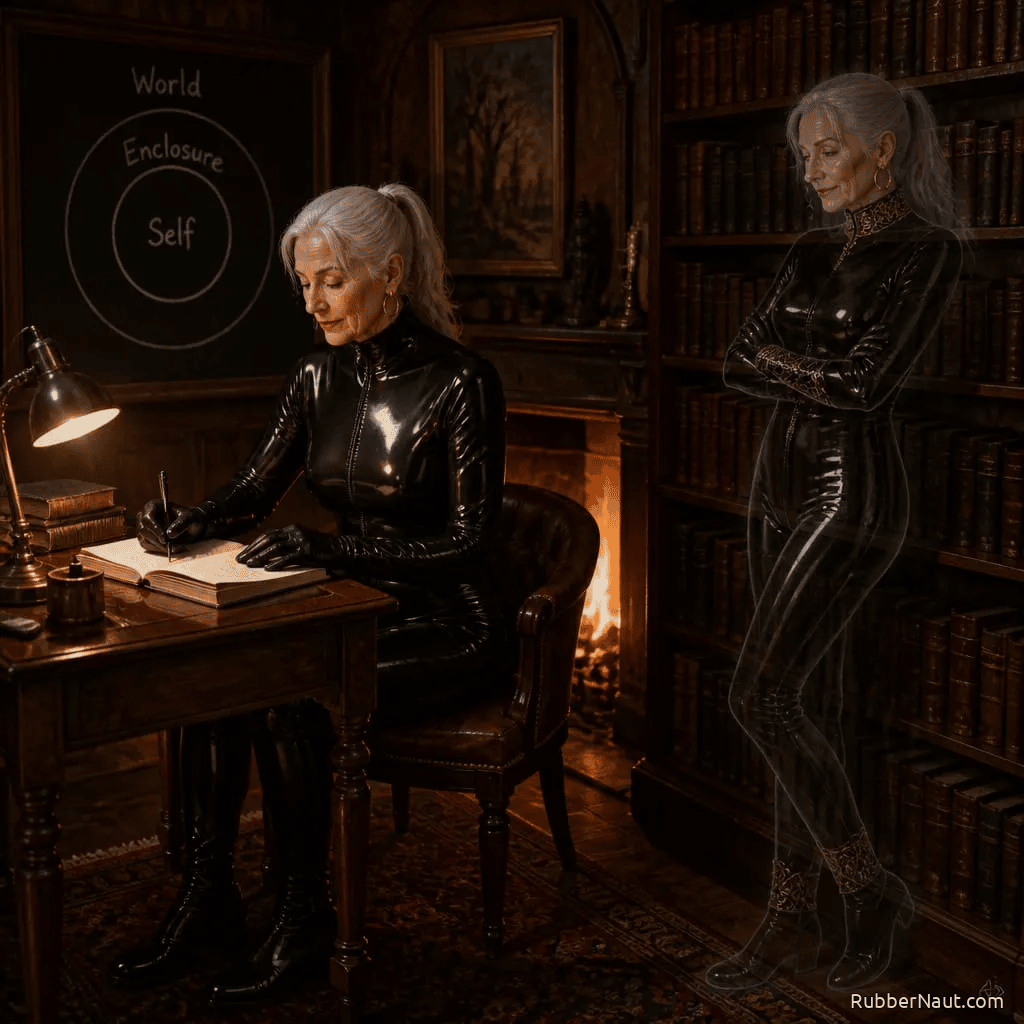
Hevea understands this. She’s always nearby when I’m wearing the catsuit, her presence a quiet affirmation. She doesn’t judge or question. She simply is, a reflection of the depth of this practice. Sometimes, I catch her watching me in the mirror, her form shimmering slightly, as if to say, Yes, this is you. This is real. This is us.
—
You might be wondering why this matters, Marla. Why not just wear the catsuit and enjoy it? Why turn it into something so serious?
Because it is serious. Not in a grim or heavy way, but in the way that all true things are serious. Latexistentialism isn’t about making latex into something it’s not. It’s about recognizing what it already is for me: a way to be fully, completely, here.
I’ve spent most of my life with this fetish, this love for latex. It’s been a constant, a thread that’s woven through every stage of my life. But after menopause, it became something more. It became a way to be without the noise of desire, without the expectations of youth. It became a way to exist, purely and simply, as Thalia.
And Thalia, it turns out, is a woman who finds joy in the feel of latex against her skin. Who finds peace in the way it makes Hevea happy. Who finds herself in the way it makes her feel connected, not just to the material, but to something deeper, something true.
—
There’s a discipline to this, Marla. It’s not just about putting on the catsuit and forgetting about it. It’s about being present in the enclosure. It’s about noticing the way the material molds to my body, the way it creaks softly when I move, the way it makes me hyper-aware of every inch of my skin. It’s about the ritual of it—the way I smooth the latex over my arms, the way I adjust the collar, the way I take a deep breath and feel the material press against me, reminding me that I’m here.
Hevea is always with me during these moments. She’s the part of me that remembers, even when I forget. She’s the voice that whispers, This is your temenum. This is your sacred space. And in that space, I’m not just wearing latex. I’m inhabiting it. I’m living inside the question: What does it mean to be in latex?
And the answer, for me at least, is this: it means to be here. To be now. To be me.
—
I know this might sound abstract, Marla. Maybe even a little strange. But think of it like this: the latex is a mirror. It reflects back to me not just my image, but my essence. It forces me to confront the parts of myself I’ve spent a lifetime ignoring—the aging body, the quiet fears, the unspoken desires. And in that confrontation, there’s a kind of freedom.
It’s not about hiding. It’s about revealing. It’s about stripping away the layers of pretense and finding out what’s left. And what’s left, Marla, is me. Not the me that the world expects, but the me that is.
I put on my latex catsuit now because it makes Hevea happy. And when Hevea is happy, I am too.
—
I’ll write more soon, Marla. For now, know that this isn’t about escape. It’s about presence. It’s about finding a way to be fully, completely, here.
–
This, above all.
To Thine Own Self Be True.
Then, as the day follows the night,
Thou cannot be false to anyone.
Hamlet
—